The Playtest Plan Belongs in the GDD

A GDD should not merely describe the intended game. It should make uncertainty visible. For each risky rule, add a compact test record: the decision under review, the player behavior that would support it, the build number, the audience, and what the team will change if the result is weak.
Write the question before the test
“Is combat fun?” cannot guide a build. “Can a first-time player explain why the flanking move worked after one encounter?” can. The second question points to a tutorial state, a combat log, an interview prompt, and an observable result.
Preserve the distinction between evidence and opinion
Store playtest observations, quotes, telemetry, and design interpretation in separate fields. A player saying “I was confused” is valuable evidence, but it does not identify the cause by itself. Link the observation to the hypothesis and record competing explanations.
Close the loop
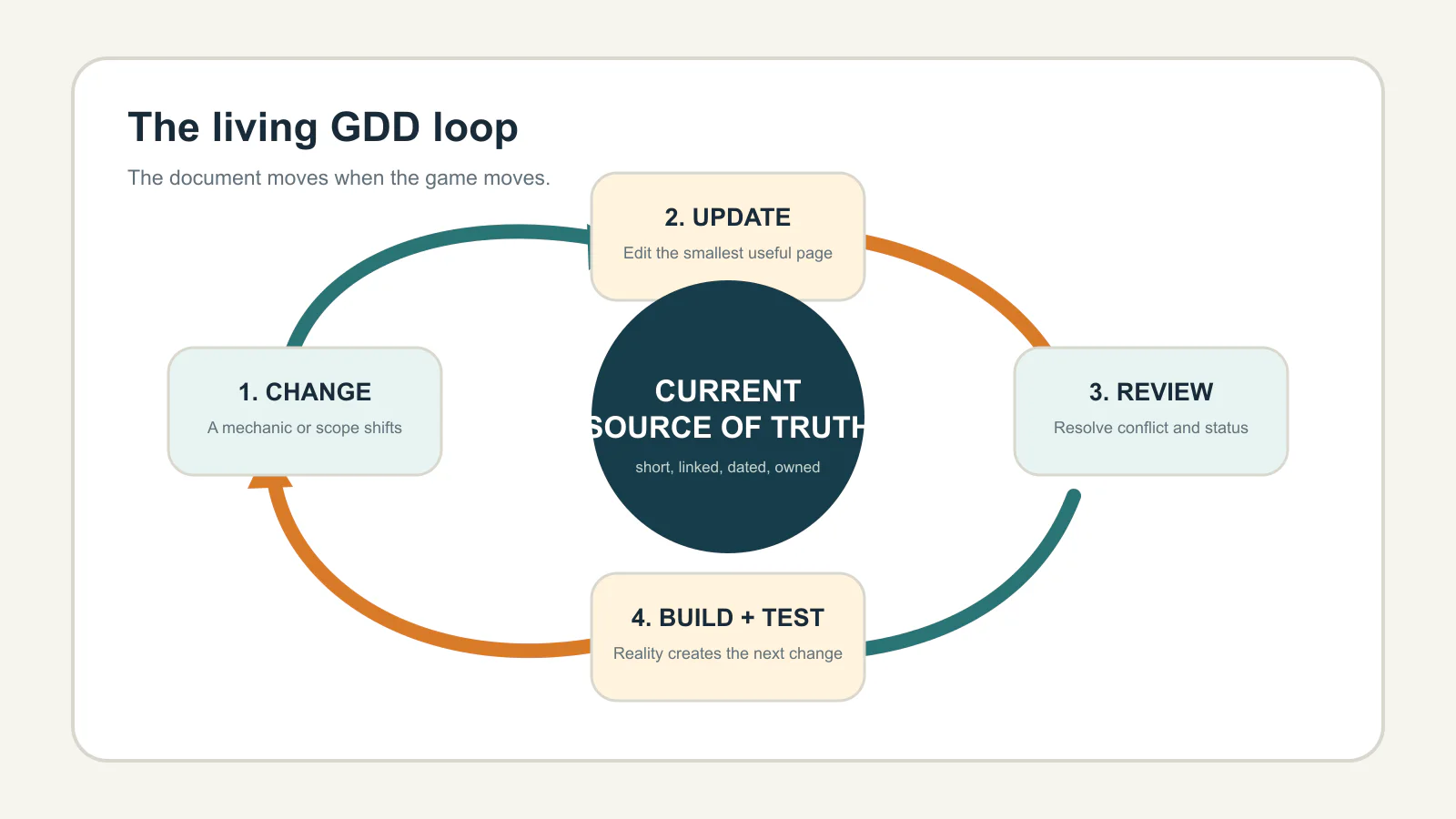
When a test finishes, update the decision status: supported, rejected, unresolved, or superseded. Link the next build and the owner. A living document earns trust because a reader can see what changed and why, not because it contains every thought the team has had.
Steam’s official Playtest feature reinforces this separation: a test app can be associated with the main game while keeping the test access and data distinct from the main store identity.
Primary source
GDDplaytestingdesign validationgame production