The AI-Written GDD Confidence Trap

Generative AI is very good at producing the shape of a design document: pillars, loops, progression, economies, personas, risks, and a confident production plan. That fluency creates a specific danger. The document can look more decided than the game actually is.
Prose is not evidence
“Combat will feel responsive” is not a requirement. “Players will remain engaged through meaningful progression” is not a tested claim. AI tends to complete these familiar sentences because they sound like game-design language.
Replace each important sentence with four fields:
- Owner: Who decides?
- Status: Hypothesis, testing, accepted, or cut?
- Evidence: Prototype, playtest, research, or constraint?
- Next test: What observation could change it?
If those fields are empty, the paragraph is an idea—not a plan.
Use AI where it is strongest
Ask it to:
- generate alternative mechanics under explicit constraints;
- identify contradictions between systems;
- turn a decision into edge cases and test scenarios;
- compress notes into a structured decision log;
- list assumptions that need owner confirmation.
Do not let it silently invent research, player feedback, budgets, legal rights, technical capability, or studio history.
NIST’s generative-AI risk profile emphasizes testing, evaluation, verification, and validation as part of managing risk. A GDD workflow can borrow that discipline: generated text remains provisional until evidence and ownership are attached.
Protect the inputs
Before uploading unreleased designs, code, licensed material, or partner information, check the tool’s data-use and confidentiality terms. WIPO’s game-development guidance warns that sending code or creative material to AI systems can create copyright or trade-secret concerns.
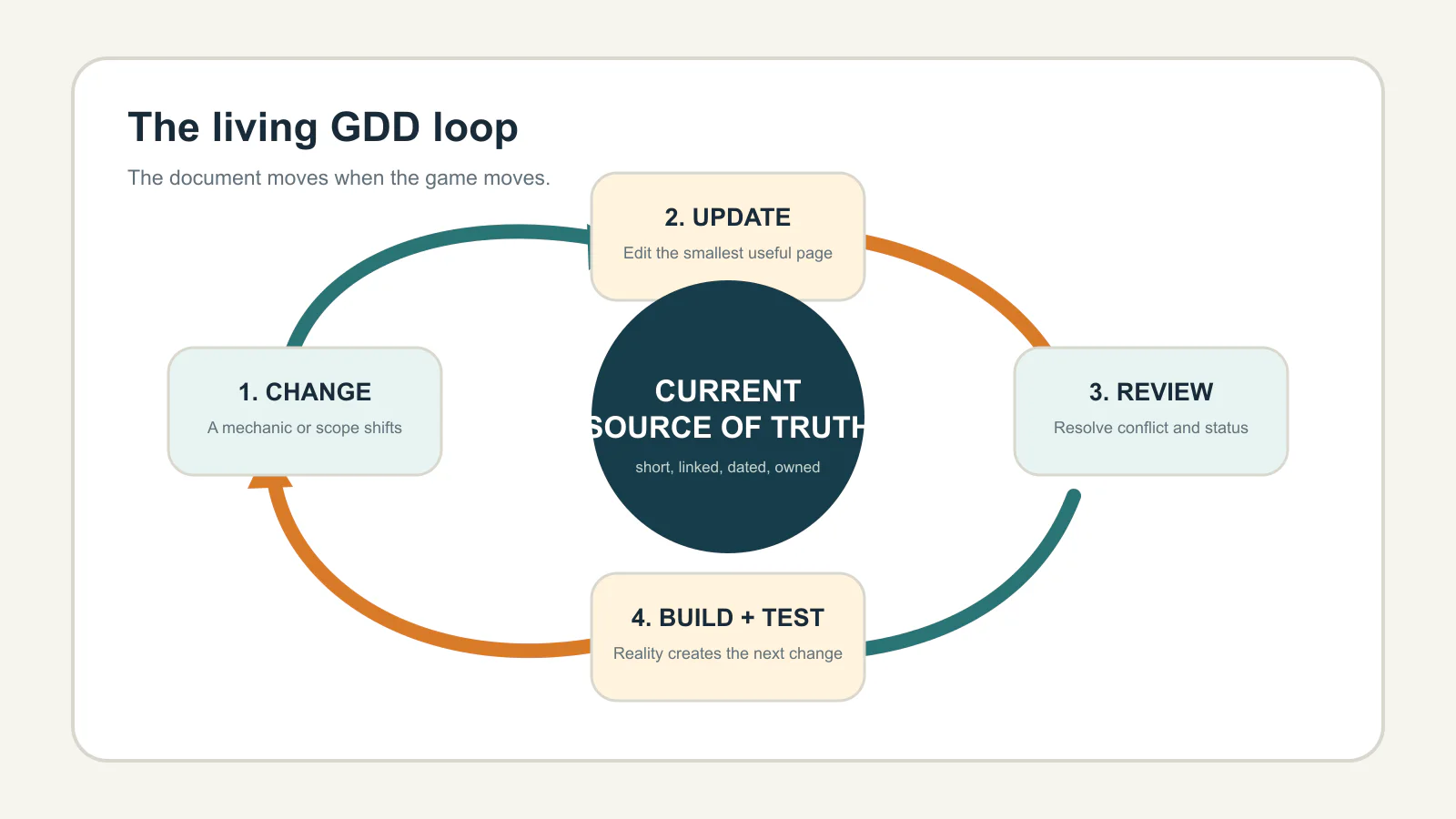
Keep a provenance note for material AI-assisted sections and preserve the human edits that made them production-ready.
Sources and limits
- NIST: AI Risk Management Framework
- WIPO: Video-game IP guidance
- U.S. Copyright Office: Copyright and Artificial Intelligence
Legal treatment and tool terms change. This is production guidance, not legal advice.
Key takeaway
AI can draft the document. It cannot supply the missing decision, evidence, owner, or playtest. Mark uncertainty visibly before polished prose disguises it.
AI game designGDDgenerative AIdesign validation