Writing a One-Page GDD That Wins a Greenlight
The people who greenlight your game are busy, skeptical, and reading their tenth pitch of the week. A hundred-page design bible does not impress them; it exhausts them. What earns a yes is a single page that makes the game obvious in ninety seconds. If you can fit your entire concept on one page and it still makes sense, you have proven something a long document never can: the idea is coherent.
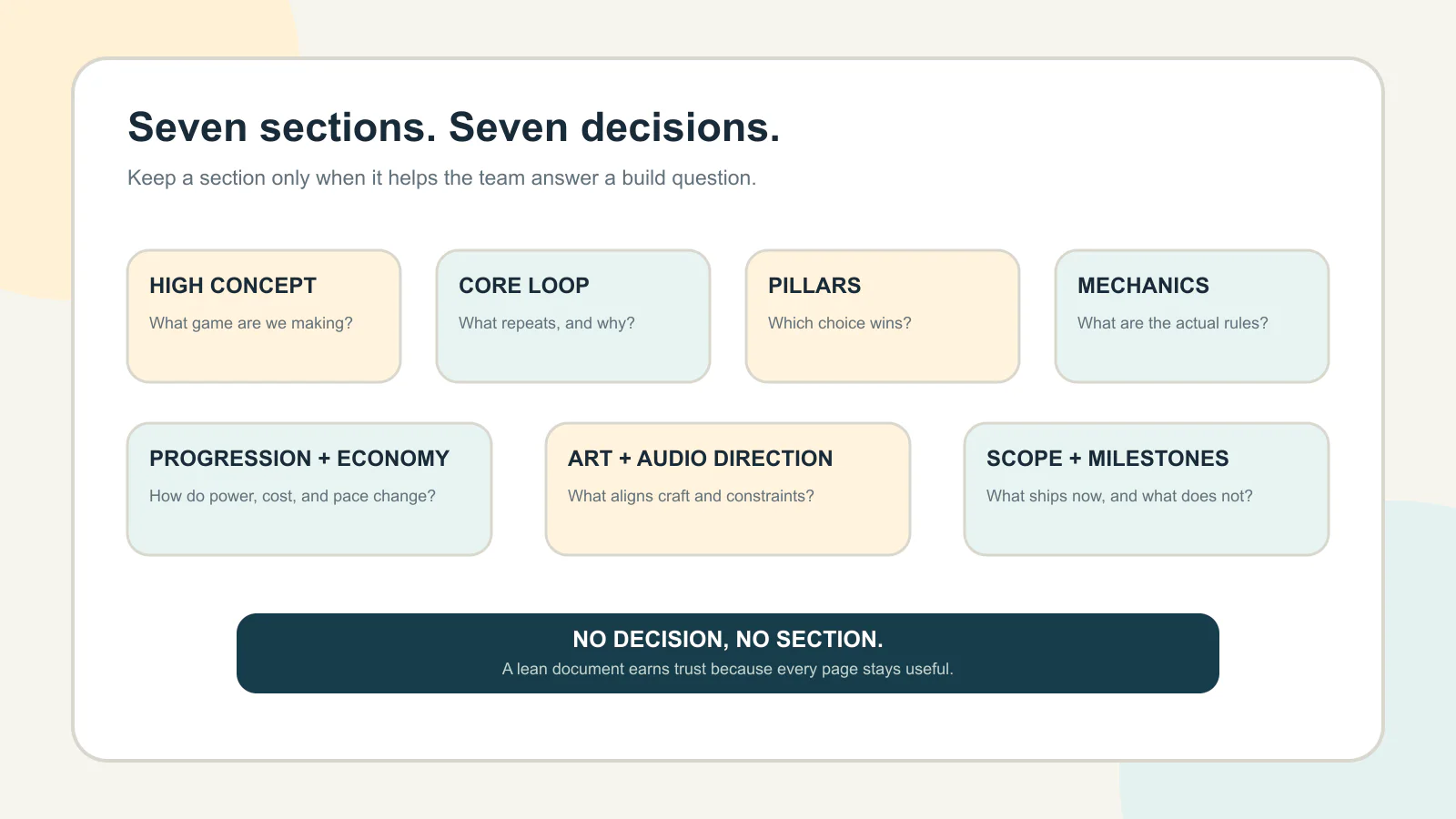
The one-page GDD, sometimes called a one-pager or a pitch sheet, is not a shrunken version of a full doc. It is a different tool with a different job. This walkthrough shows what goes on the page and, just as important, what stays off.
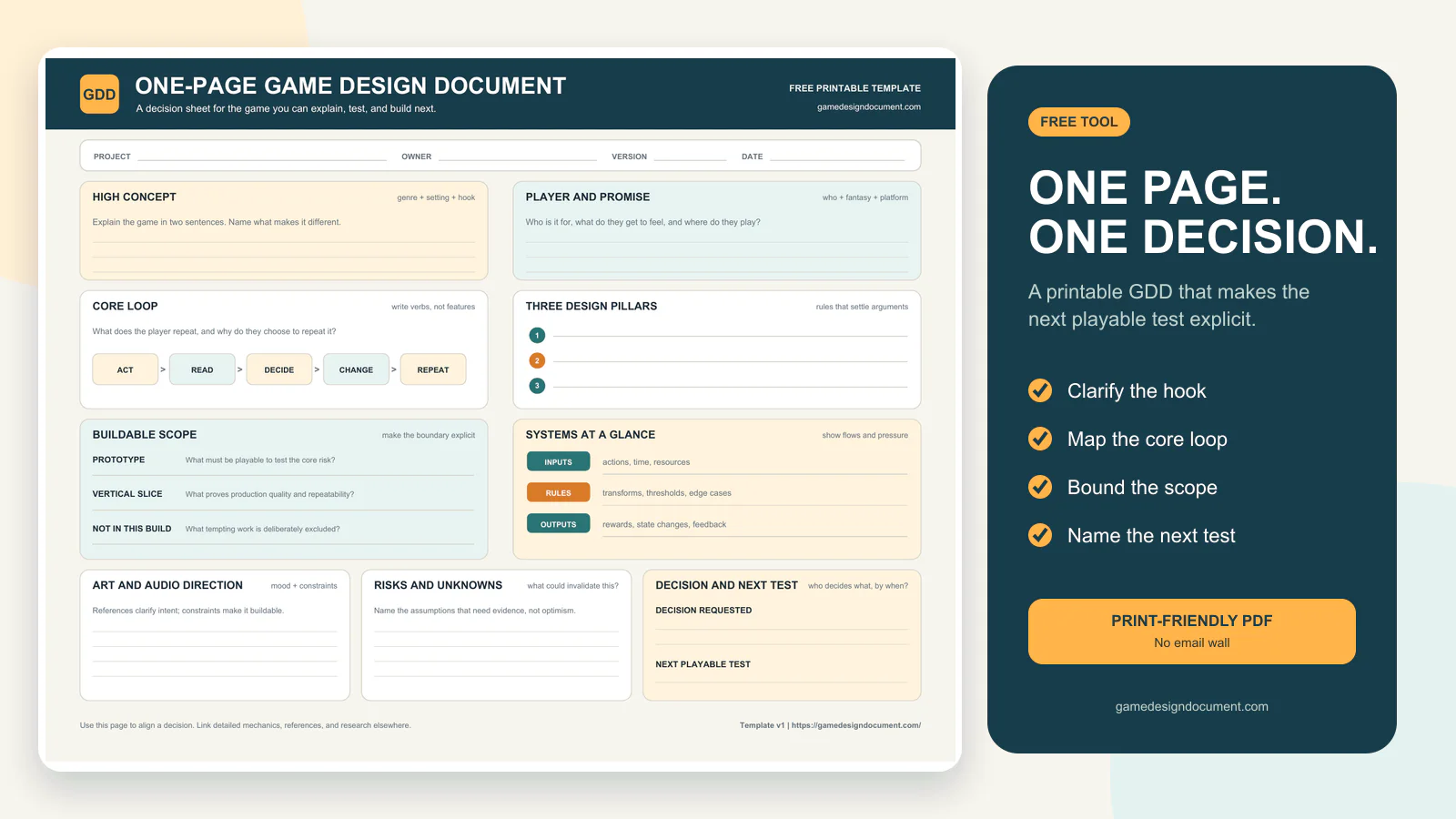
Download the free one-page GDD template
What Goes on the Page
A strong one-pager reads top to bottom in a single glance. Work through these blocks in order, keeping each to a few lines.
- Title and tagline. The name, plus one line that captures the fantasy. “A sci-fi survival game where your broken mech is both your shelter and your enemy.”
- High concept. Two or three sentences on genre, setting, and the core hook. What makes this different from the obvious comparison title?
- Core loop. The repeating gameplay described as verbs. Explore, salvage, repair, defend. Someone should picture the game from this alone.
- Unique selling point. The single thing this game does that others do not. One point, stated plainly.
- Target player and platform. Who plays this, and where. A short audience sketch beats a demographic table.
- Scope and status. Team size, target length, current stage, and what the requested greenlight unlocks.
- Visual anchor. One piece of concept art, a mockup, or a mood image. A picture carries tone faster than a paragraph.
That is the whole page. Everything competes for the same limited space, which forces you to rank what actually matters.
A Worked Example
Here is how the blocks might read for a compact sci-fi survival pitch. Notice how each line does one job and stops.
| Block | Example content |
|---|---|
| Tagline | Repair your dying mech before the cold does it for you. |
| High concept | A solo survival game on a frozen moon; your mech is shelter, tool, and liability. |
| Core loop | Scout, salvage parts, repair systems, survive the night, push deeper. |
| Unique selling point | The mech degrades in real time, so every trip is a risk-versus-warmth decision. |
| Target player | Survival-craft fans who want tension over grind; PC first. |
| Scope and status | Two-person team, playable prototype done, greenlight funds a six-month vertical slice. |
Read those six rows straight through and the game is clear. That clarity is the product. Studios pitching sci-fi survival concepts like MECH Stranded lean on exactly this kind of compression to get a decision-maker nodding before they turn the page.
What Stays Off
The one-pager fails the moment it tries to be complete. Keep these off the page entirely:
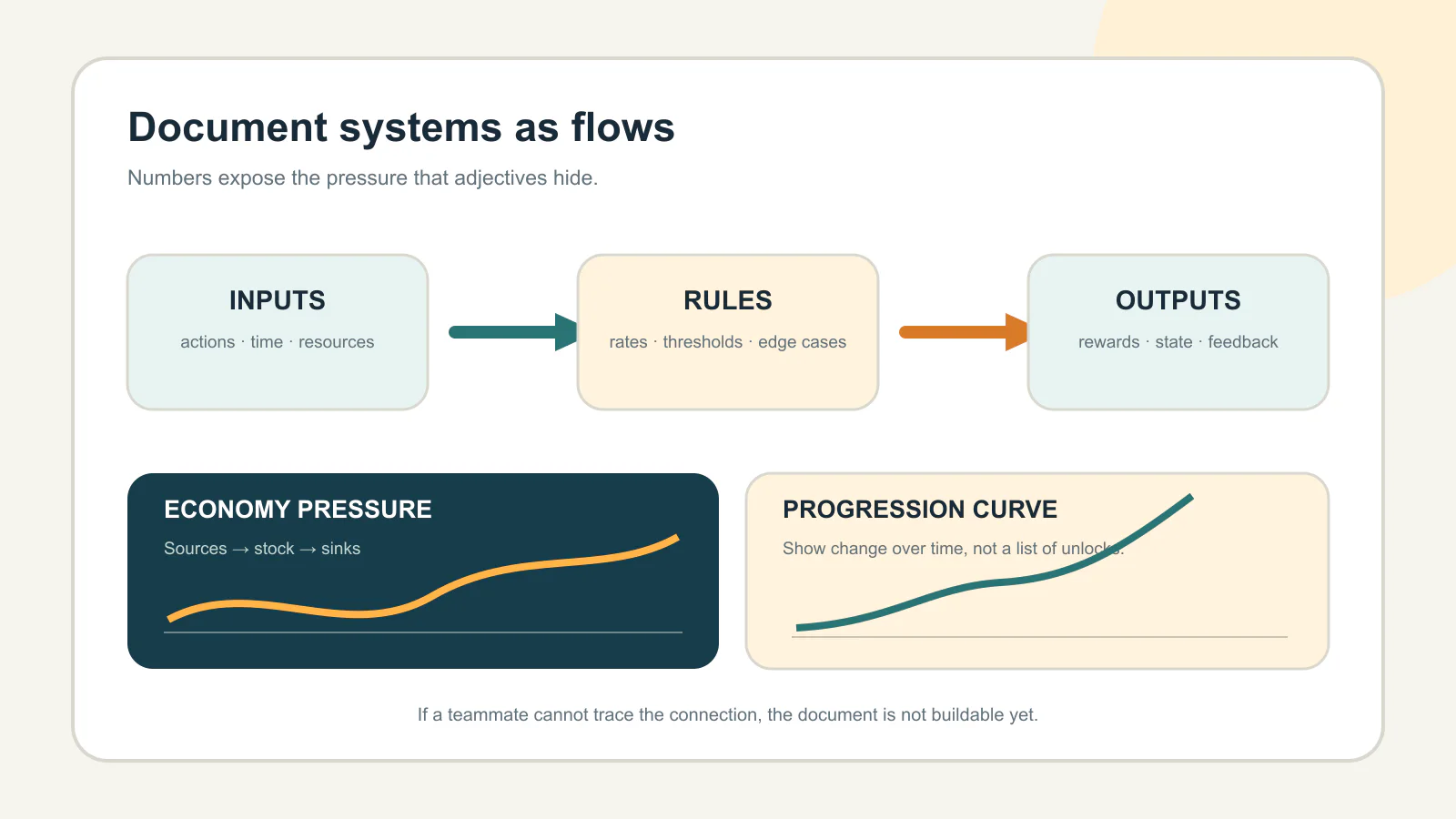
- Full mechanics breakdowns and formulas.
- Detailed economy or progression tables.
- Extended lore and character bios.
- Marketing and monetization plans.
All of that lives in your full GDD, ready if the reader asks for more. The one-pager’s only job is to earn that second conversation.
Design the Page, Not Just the Text
Layout carries weight here. Use clear headers, generous whitespace, and a single strong image. A wall of dense text signals a game that has not found its focus, even if the words are good. Read the page out loud in under two minutes. If you run long or stumble, cut until it flows.
FAQ
Is one page ever too short for a complex game? No. Complexity is exactly why you compress. If a deep systems game cannot be summarized in a page, the pitch is not ready, even if the design is.
Should the one-pager and full GDD say the same thing? They should never contradict, but the one-pager is a persuasion tool and the GDD is a working reference. Same game, different jobs.
Do I need concept art if I cannot draw? A rough mockup, a reference collage, or a clean UI sketch all work. The point is to anchor tone visually, not to ship final art.
Key Takeaway
A one-page GDD is a decision tool, not a summary. Fit the whole idea on one page and you prove the concept is clear enough to fund.
Sources: Nuclino, Indie Game Academy, Generalist Programmer
gddone-pagepitchgreenlighttemplates